
Inhalt: Honey Bee Higher Tier and Monitoring Working Group
History and Aims
The ICPPR Honey Bee Higher Tier and Monitoring Working Group (HBHT&M WG) was formed from a merger of two other successful ICPPR WGs; the Brood Testing Working Group (BTWG) and the Semi-Field/Field Testing Working Group (SF/FTWG). Each of the previous working groups consisted of a number of sub-groups/writing groups whose aims were to develop or improve technical guidance could be used by industry, regulators and academic and researchers in regulatory risk assessment. There was a large amount of cross-over and joint membership of the two working groups and the decision was taken to merge the two.
Inhalt: Chairs and Contact
Lukas Jeker, Agroscope Switzerland
E-Mail: lukas.jeker@agroscope.admin.ch
Mark Miles, Bayer AG
E-Mail: mark.miles@bayer.com
Verena Taenzler, Bayer AG
E-Mail: verena.taenzler@bayer.com
Selwyn Wilkins, Fera
E-Mail: selwyn.wilkins@fera.co.uk
Inhalt: Current Activities
The group's overarching aim is to advance, standardize, and improve higher-tier honey bee testing and monitoring methods that can be used in regulatory risk assessment of plant protection products. The outputs are intended for use by regulators, industry, academia, and contract research organizations.
Large Scale Colony Feeding Studies
Established in 2017, the LSCFS Working Group aims to advance and harmonize the design, conduct, evaluation, and interpretation of Large-Scale Colony Feeding Studies using free-foraging honey bee colonies under natural environmental conditions.
The group is currently finalizing a comprehensive Guidance Document that provides scientifically robust and regulatory-relevant recommendations for assessing chronic dietary exposure and colony-level effects in higher-tier honey bee risk assessments. Following three rounds of review and input from ICPPR members, the document is planned for submission to the OECD in 2026, with the aim of promoting broader regulatory acceptance of data generated through this study design.
The Guidance Document will serve as a valuable resource for regulatory authorities, registrants, and the wider scientific community.
Residues
The Residues Sub-Working Group aims to develop and harmonize scientific guidance for the design, conduct, analysis, and interpretation of bee-relevant residue studies. The group focuses on improving the consistency, robustness, and regulatory utility of pollen, nectar, and other exposure data used in higher-tier honey bee risk assessments, including recommendations on study design, sampling strategies, analytical methods, and data evaluation.
Sub-lethal Effects
The Sublethal Effects Working Group aims to improve the understanding, assessment, and regulatory interpretation of sublethal effects in honey bees. The group focuses on identifying biologically relevant endpoints, evaluating links between sublethal responses and protection goals, and developing scientifically robust approaches for incorporating sublethal effects into higher-tier risk assessments
Semi-Field/Field Methods
To advance and harmonize semi-field and field study methodologies for honey bee risk assessment through the development of scientifically robust guidance on study design, conduct, endpoint evaluation, exposure verification, and data interpretation. The group aims to improve the consistency, reliability, and regulatory relevance of higher-tier studies used to assess colony-level effects under realistic exposure conditions.
Inhalt: Past Activities and Publications
Conceptual Framework
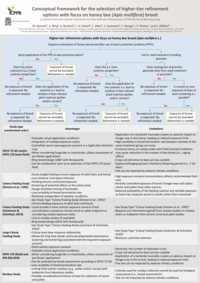
Draft guidance framework was produced giving guidance on when to use higher‑tier honey bee brood tests (OECD 75, Oomen, large-scale feeding) after lower-tier effects have been identified. For file see Downloads section.
Revision OECD Guidance 75
OECD Guidance Document was significantly revised to bring into the 21st Century; and includes digital photographic brood assessments, the option of 2 brood assessments and updated terminology. This was successfully published as the 2nd Edition December 2024:
OECD (2024), Guidance Document on the Honey Bee (Apis Mellifera L.) Brood test Under Semi-field Conditions, Second Edition, OECD Series on Testing and Assessment, OECD Publishing, Paris, https://doi.org/10.1787/542b7d72-en.
Modification of Oomen et al. Method
The working group undertook an evaluation of historical control data and made updates and included recommendations regarding chronic testing as an option, this has been published as an EPPO Bulletin:
The Oomen bee brood feeding test – revision of the method to current needs and developments.
Bulletin OEPP/EPPO Bulletin (2019) 49 (1), 137–146 The Oomen bee brood feeding test – revision of the method to current needs and developments. Bulletin OEPP/EPPO Bulletin (2019) 49 (1), 137–146, https://doi.org/10.1111/epp.12553