

Inhalt: Bee Modelling Interest Group
History and Aims
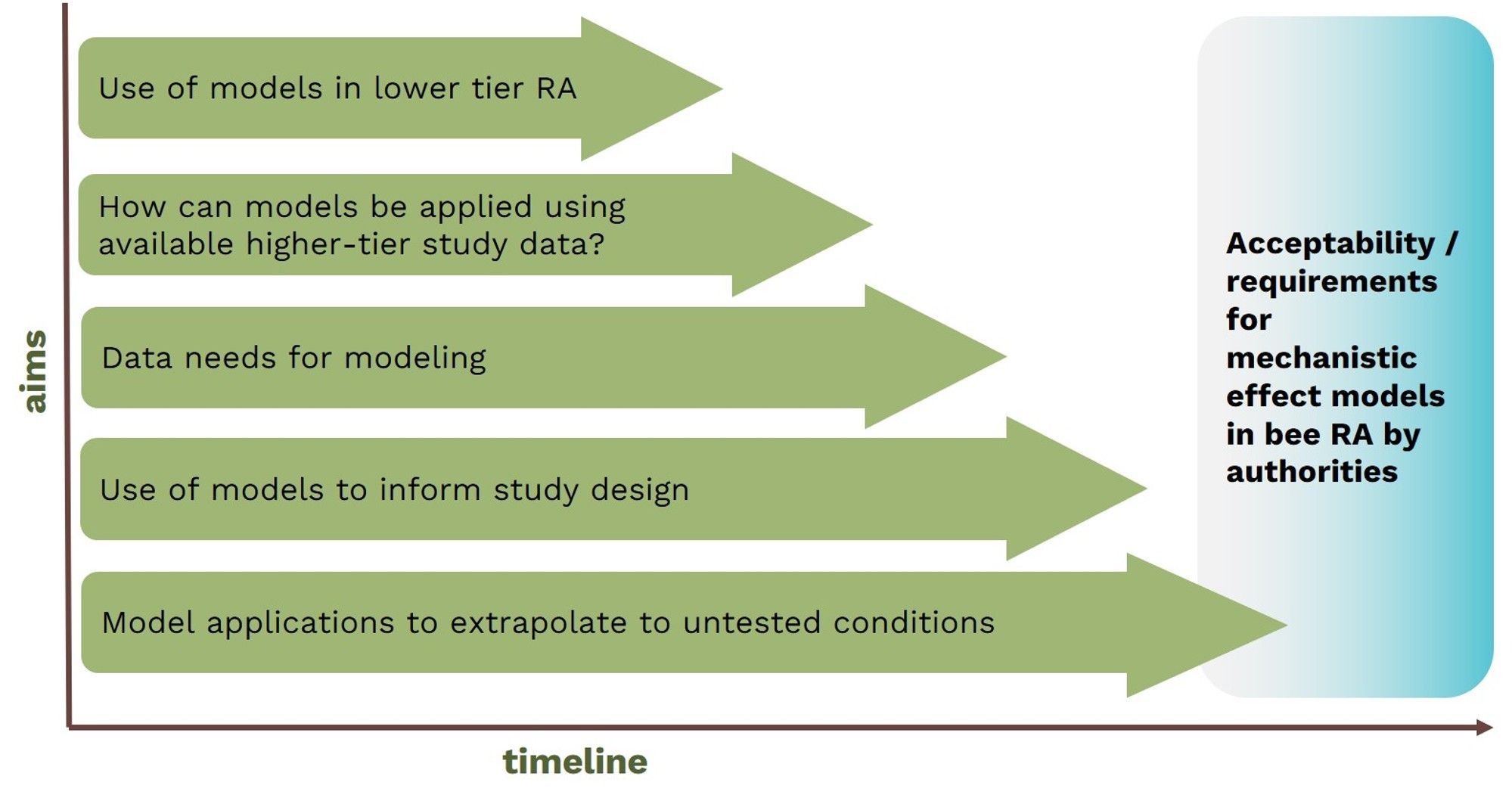
The Bee Modelling Interest Group was established in fall 2024 to advance the use of mechanistic pesticide exposure and effects models in pollinator risk assessments. The interest group provides a collaborative platform bringing together experts from diverse backgrounds including regulatory authorities, academia, contract research organisations, and industry. Through regular meetings (approximately 3 per year) and focused work groups, members work to increase the acceptability and utility of bee models for regulatory decision-making.
The Interest Group addresses several key challenges in pollinator risk assessment, including data needs for modelling, use of models to inform study design, model applications for extrapolation to untested conditions, and the use of models in higher-tier risk assessments.
Inhalt: Chairs and Contact
Amelie Schmolke
E-Mail: amelie.schmolke@rifcon.de
Jeffrey Minucci
E-Mail: minucci.jeffrey@epa.gov
Vanessa Roeben
E-Mail: vanessa.roeben@bayer.com
Johannes Lückmann
E-Mail: johannes.lueckmann@rifcon.de
Inhalt: Current Activities
Work Group 1: Exposure Routes & Fate
The Exposure Routes & Fate Work Group focuses on improving the characterisation of pesticide fate and transport in bee-relevant matrices for both honey bees and non-Apis bees. This group places particular emphasis on poorly characterised exposure pathways that may be critical for comprehensive bee risk assessment. Areas of focus include:
- Exposure routes for ground-nesting bees, particularly pesticide residues in soil
- Pesticide fate and transport modelling in various environmental matrices
- Exposure characterisation for diverse bee taxa with different foraging and nesting behaviours
- Integration of exposure models with empirical residue data
Work Group 2: Sublethal Effects
The Sublethal Effects Work Group addresses the challenge of translating individual-level sublethal effects observed in laboratory and field studies to colony and population-level outcomes. Sublethal effects such as behavioural changes, reduced foraging efficiency, or impaired learning can have significant implications for colony health and survival, but are difficult to assess directly in higher-tier studies. Areas of focus include:
- Identification of sublethal effects from empirical studies
- Review of data sources with the potential to inform sublethal effects modelling
- Development of modelling approaches to scale individual effects to colony and population levels
Work Group 3: Model Inventory
The Model Inventory Work Group is developing a comprehensive summary of available models for honey bees and non-Apis bees that could be relevant for regulatory risk assessments. This inventory will serve as a resource for the broader community and helps identify where modelling capabilities are well-developed and where knowledge gaps exist. Areas of focus include:
- Documenting available colony and population models for various bee species
- Assessing model characteristics, validation status, and accessibility
- Identifying knowledge gaps and priority areas for future model development
- Providing guidance on model selection for specific risk assessment scenarios
Inhalt: 1st ICPPR Symposium on Bee Effect Models - March 17, 2026 | Lectuers and Video
-
Jeff Minucci; Tom Purucker: BeePop+: An Agent-Based Honey Bee Colony Model for Pesticide Risk Assessment
1st ICPPR Symposium on Bee Effect Models - March 17, 2026
( pdf )
-
Vanessa Roeben; Dominik Lammers; Thomas G. Preuss: BEEHAVE and BumbleBEEHAVE plus ecotox: Tools for linking standard lab studies to colony dynamics
1st ICPPR Symposium on Bee Effect Models - March 17, 2026
( pdf )

-
Amelie Schmolke: SolBeePopecotox - A Population Model for Solitary Bees
1st ICPPR Symposium on Bee Effect Models - March 17, 2026
( pdf )
-
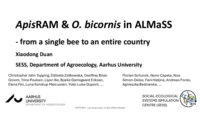
Xiaodong Duan: ApisRAM & O. bicornis in ALMaSS - from a single bee to an entire country
1st ICPPR Symposium on Bee Effect Models - March 17, 2026
( pdf )
Inhalt: Video
Inhalt: Past Activities, Publications and Downloads
1st ICPPR Symposium on Bee Effect Models - March 17, 2026
Inventory of mechanistic bee models by the ICPPR Bee Modelling Interest Group (Work Group 3)
Chon, K., Deslandes, L., Duan, X., Grimm, V., Le Page, G., Minucci, J., Schmolke, A., Tagliati, A., Vaugeois, M., & Zoupa, M. (2026). Inventory of mechanistic bee models by the ICPPR Bee Modelling Interest Group (Work Group 3) [Data set]. Zenodo. https://doi.org/10.5281/zenodo.20800079